
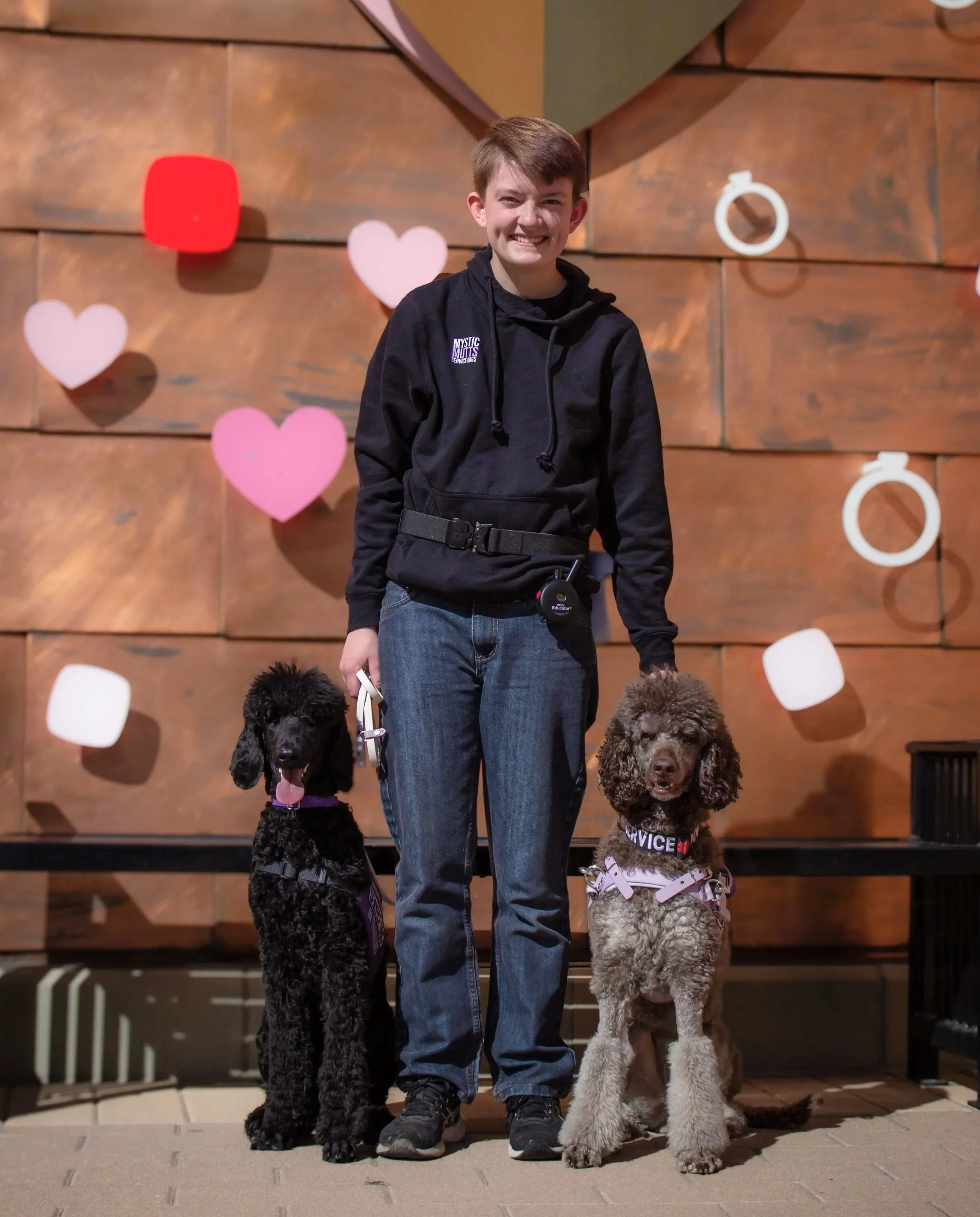
Hi there, my name is Trin Lively.
From a young age, I’ve been passionate about two things. Animals, and teaching. I’ve always said that if I couldn’t work in the pet industry, I’d be a teacher, a zoologist, a historian, something that would allow me to spend my career telling people about the things I was passionate about. Luckily, I’ve been able to dedicate myself to the field of dog training.
Now, I hold Master Dog Trainer certification from the 960-hour in-person International School for Dog Trainers’ program (including over 300 hours of service dog specific training) and affiliate membership with the International Association of Canine Professionals. Since graduating from the School for Dog Trainers in 2023, I have continued my education nonstop through seminars, mentorships, and other opportunities. I pride myself on my level of expertise in the work that I do, and in my passion for sharing that expertise with my clients.
Jinx is my Standard Poodle, who has been successfully working as my service dog since early 2024 and holds multiple titles, including an Excellent title in Rally Obedience and multiple UKC Total Dog and High In Trial awards as we begin to work towards Rally championship status this year. She is also my “mentor dog”, serving as a balanced, social, and reliable aid to other dogs as they overcome a lack of socialization or trauma.
Feel free to read a bit about my methods and philosophies below. I look forward to working with you and your dog!
There are as many approaches to dog training as there are dog trainers. However, my personal approach and philosophy are simple to understand and grounded in the practical study of how dogs think, live, and learn.
My Philosophy
Empowerment First.
I believe that the most important component of a trained dog is the skill of independent problem-solving. I don’t just teach dogs to follow commands- I teach them how to manipulate outcomes. A dog who always believes they are capable of finding the right answer is a dog who will work through an emergency, a high-level distraction, or a medical episode without micromanagement.
Human-Centered
The best training plan in the world fails if the person living with the dog cannot understand or apply it. A majority of my lessons are focused on the human end of the leash, building your confidence and understanding of various exercises so that you can apply them effectively and see results with your dog long after I leave.
Relationship-Focused
A dog who knows commands is nothing without a handler they trust, enjoy, and respect. A priority of my training system is developing a healthy, positive relationship between dog and handler, and coaching owners on how they can become someone their dog looks to for guidance, rather than someone they ignore, avoid, or leave for distractions.
My Methods
-
Every dog is different, and every dog-handler team is different. I work with a wide variety of breeds, personality types, and ages, and all require a slightly different approach to training. Each program is truly customized to each team, and tools and techniques we use are tailored to each dog.
-
I spend as little time as possible during lessons actually holding your dog’s leash. Why? Because in the 167 hours a week I’m not with you, you are the one following through on training. If you don’t understand how to apply and practice each exercise with your dog, I’m setting you up to fail. 20% of lessons is spent demonstrating techniques and handling your dog for you. 80% is teaching, coaching, and perfecting you as you learn to train and work with your own dog.
-
Dogs are inherently selfish creatures. I say that with all of the love and respect in the world. But a dog who is not highly motivated is a dog who will not perform when it counts. My system and methods focus heavily on building motivation and “drive” in the dog for food, toys, and your affection so that we can use positive reinforcement to build strong, reliable behavior.
-
I frequently work with neurodivergent and physically disabled handlers who require adaptation in techniques & exercises. My primary focus when developing a training plan is ensuring it is attainable for you, and explaining it in a manner you can understand. I am experienced in accommodating disability-related needs in my programs.